Actions: Serverless Python Functions That Let Your Data Respond

You've connected your sources. You've built your pipelines. Your golden tables are clean, your agents are running, your dashboards are live. The data flows, but it mostly stays inside Datazone. What happens when something in that data needs to trigger something outside of it?
A record gets flagged. A threshold is breached. A new customer lands in the CRM. Someone needs to be notified, a downstream system needs to be updated, a third-party service needs to be called. Until now, that meant wiring up a separate tool, writing glue code, and maintaining yet another integration.
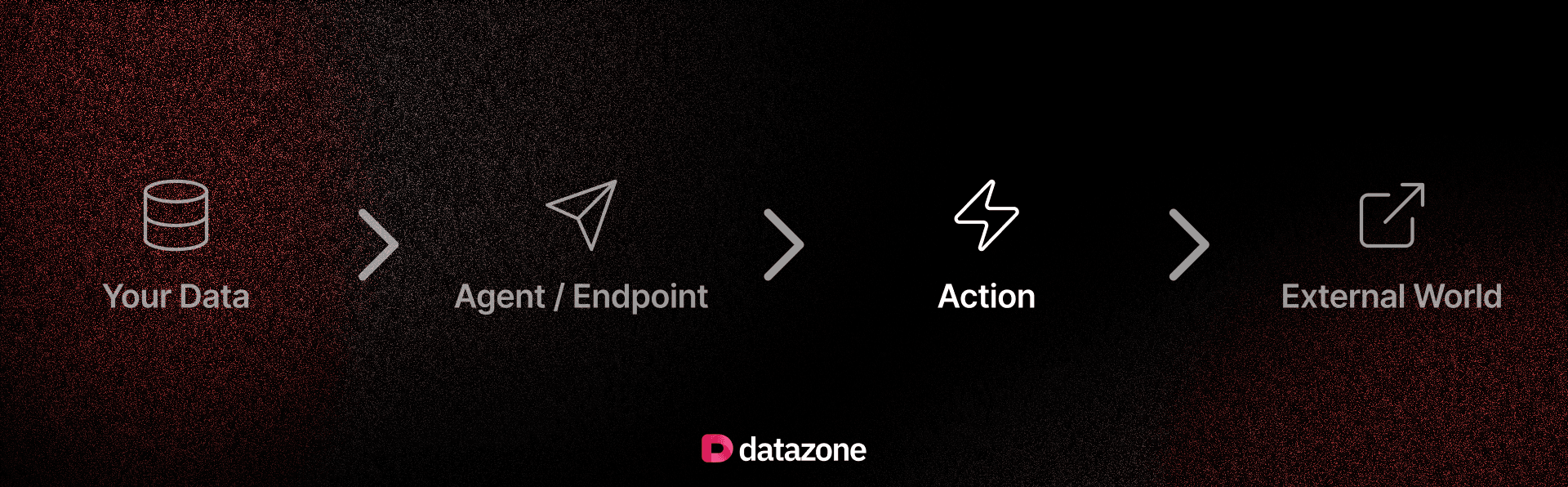
Actions are serverless Python functions that live inside your Datazone project. Write the logic. Deploy it. Attach it to an endpoint, hand it to an agent, done. When something needs to happen, the function runs. No extra infrastructure. No compiling ceremony.
What Actions actually do
The function itself is straightforward Python. What changes is where it runs and what triggers it. Here are two patterns that show up across the teams using Actions today.
Agent Tools
Give your AI agent the ability to act, not just answer. A support team deploys a Datazone agent on top of their customer data. Without Actions, the agent can pull records and answer questions. With an Action attached as a tool, the agent can also update ticket status, trigger a refund workflow, or send a confirmation email, all from the same conversation, decided by the agent based on what the user actually needs.
Endpoint Triggers
Expose a function as a callable HTTP endpoint. A finance team runs month-end reports in Datazone. Instead of someone manually kicking off the process, the report generation Action is connected to an endpoint. Their ERP system calls it on schedule, or a team member hits it from a Postman tab. The report runs, the output gets stored, and a summary gets emailed. No one has to remember to do it.
What writing an Action looks like
You write a standard Python function and decorate it with @action. Datazone handles the execution environment, logging, and how it gets called, whether from an agent or an API endpoint.
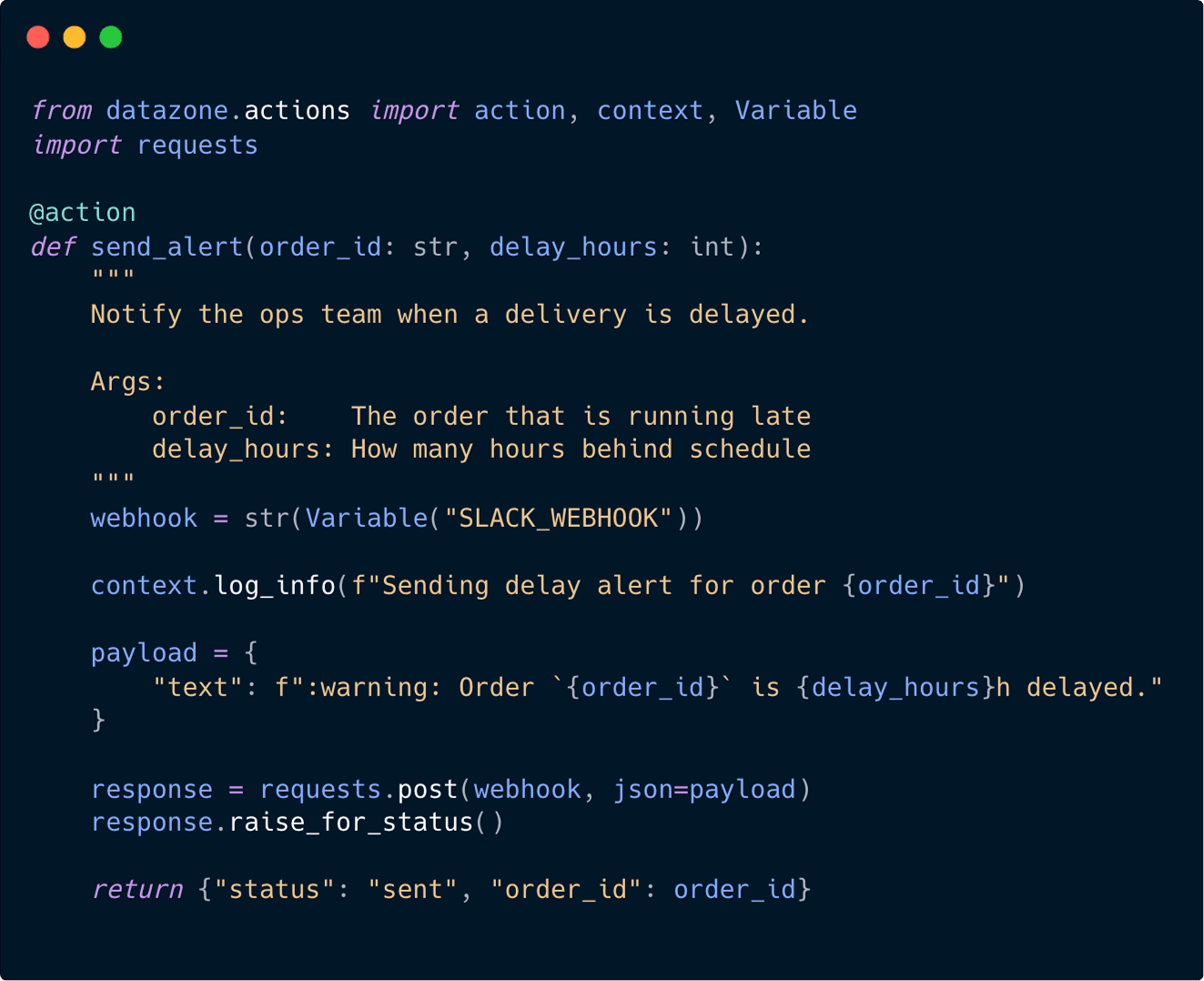
Sensitive credentials, webhook URLs, API keys, tokens, are stored as encrypted Variables in Datazone and referenced by name. They never appear in source code.
Two ways to use them: Endpoints and Agents
Attached to an Endpoint — Connect an Action to a Datazone Endpoint and it becomes a callable HTTP API. External systems, schedulers, or internal tools can trigger it on demand, with authentication and authorization built in.
Used as an Agent Tool — Give an Action to an Agent and the AI decides when and how to call it. The agent reads the function description, understands what it does, and invokes it when the user's request calls for it. No extra wiring required.
Both paths use the same underlying function. You write it once. How it gets invoked is a configuration decision, not a code change.

The data platform has always been good at the inward work: ingesting, cleaning, transforming, serving. Actions extend that outward. When your data sees something, your systems can now respond to it.

Still chasing data across tools and teams?
Datazone unifies your data workflows — faster, clearer, smarter.
Get Started – It’s Free